AI & Vision 2030: Opportunities for Health-Tech Vendors in Saudi Arabia
Key Takeaways
- Saudi Arabia’s Health Sector Transformation Program is creating the infrastructure for AI-driven, connected, and preventive healthcare.
- From AI clinical decision support and predictive analytics to patient management, remote monitoring, smart hospitals, and healthcare automation, AI can address multiple healthcare workflows.
- Successful AI healthcare solutions in Saudi Arabia need strong data security, Arabic-language capabilities, interoperability with healthcare systems, and alignment with local requirements.
- Healthcare AI vendors need to demonstrate clinical reliability, measurable outcomes, appropriate human oversight, and regulatory readiness before scaling across the Saudi healthcare ecosystem.
Introduction
Saudi Arabia’s Vision 2030 is reshaping healthcare solutions through digital transformation, AI adoption, and the Health Sector Transformation Program. Explore key AI healthcare solutions in Saudi Arabia, emerging opportunities for health-tech vendors, and the technologies shaping the Kingdom’s digital health ecosystem.
This infrastructure creates opportunities for artificial intelligence in healthcare across diagnostic imaging, AI clinical decision support, predictive healthcare analytics, patient management, remote monitoring, and healthcare automation. For health-tech vendors, however, adoption involves more than deploying accurate AI models. Solutions must address data security, interoperability, Arabic-language capabilities, clinical validation, regulatory requirements, and integration with existing healthcare workflows.
As Saudi healthcare continues shifting toward preventive, personalized, and digitally enabled care, AI is becoming an important technology layer within the Kingdom’s broader healthcare transformation.
Why Saudi Arabia Is Becoming a Healthcare AI Hub
Saudi Arabia is undergoing a major transformation in healthcare, driven by Saudi Vision 2030 healthcare objectives and the Health Sector Transformation Program (HSTP). The transformation combines digital infrastructure, integrated care, prevention, and data-driven healthcare delivery, creating a stronger foundation for artificial intelligence in healthcare.
AI can operate across this ecosystem at several levels. AI medical software can support diagnostic imaging and clinical analysis, while predictive models can identify patient risks and support preventive interventions. At the operational level, healthcare automation solutions can assist with documentation, patient routing, scheduling, and resource allocation.
Saudi Arabia’s digital-health strategy also emphasizes connected health-information systems, electronic medical records, remote consultations, clinical decision support, and advanced diagnostic tools.
This creates opportunities across AI healthcare platforms, predictive healthcare analytics, virtual care, remote monitoring, and AI-enabled patient management. However, healthcare AI requires more than model accuracy. Interoperability, data governance, clinical validation, cybersecurity, and human oversight are essential for deploying AI safely within healthcare environments.
The result is an emerging Saudi digital health ecosystem where AI can become an enabling layer across clinical, operational, and preventive healthcare.
The Health Sector Transformation Program is one of Saudi Vision 2030’s programmes and aims to improve healthcare access and quality while strengthening prevention and accelerating digital transformation. These initiatives are contributing to a broader healthcare innovation KSA landscape in which AI, digital health, IoT, biotechnology, and other technologies are being evaluated within healthcare environments.
The transformation extends beyond digitizing existing services. It involves developing a more integrated healthcare ecosystem in which health data, providers, digital platforms, and care pathways can work together. Saudi Arabia’s e-health strategy identifies connected health-information systems, electronic medical records, remote consultations, clinical support, and advanced diagnostic tools as important components of this infrastructure.
For AI, this creates three important technical foundations:
- Data: structured and longitudinal healthcare data can support analytics and machine-learning models.
- Connectivity: interoperable systems allow AI applications to access and exchange relevant information.
- Prevention: population-health data can support earlier identification of health risks.
The Ministry of Health is also supporting experimentation through its Health Innovation Sandbox, which covers digital health, AI, IoT, biotechnology, and other technologies.
Why Artificial Intelligence in Healthcare Is Becoming Critical for Saudi Arabia
Saudi healthcare is generating increasingly complex clinical and operational data, making artificial intelligence in healthcare useful for converting information into actionable insights. AI can support clinicians, automate repetitive workflows, and help healthcare organizations identify risks earlier.
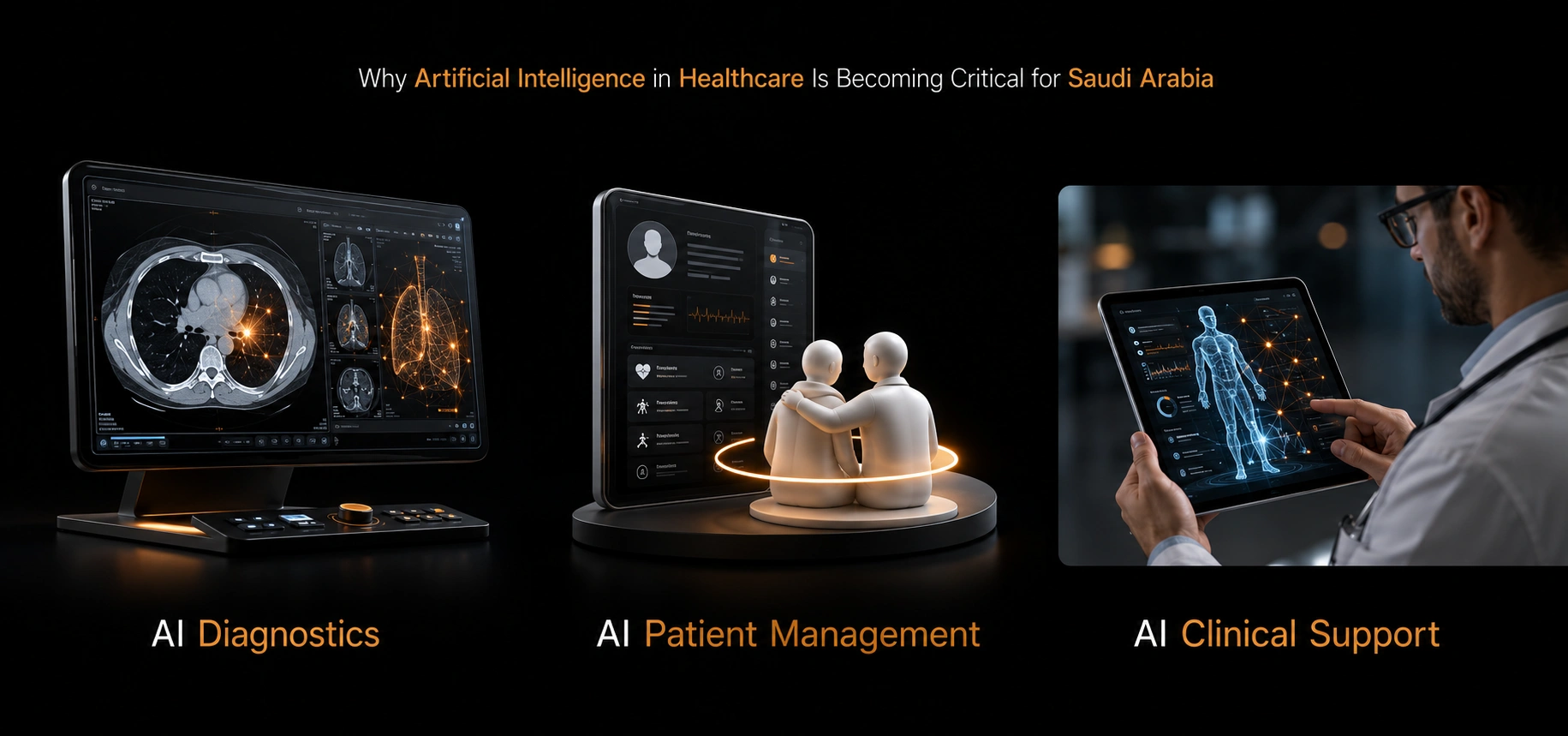
1. AI Diagnostics
Computer vision and machine learning can assist with medical imaging, pathology, ophthalmology, and screening. These systems can prioritize abnormal findings and provide decision-support signals while keeping clinicians responsible for final interpretation.
2. AI Patient Management
AI patient management systems can automate appointment coordination, triage, follow-ups, patient communication, and care navigation. This becomes particularly relevant as digital and virtual-care services expand across Saudi Arabia.
With the increasing demand for these services, specialized platforms are emerging to support these workflows at scale. Take Maica, for example, an AI-powered patient management ecosystem that simplifies the whole patient journey. Maica uses conversational AI to automate front desk inquiries, appointment setting and personalized cross-channel follow-up messages. This allows healthcare providers in the country to manage a high volume of patient interactions efficiently while delivering a human-centric experience, thus reducing the administrative burden and increasing patient access to care.
3. AI Clinical Support
AI clinical decision support can analyze longitudinal patient information, identify potential risks, summarize clinical records, and surface relevant information during care delivery. Generative AI and NLP can additionally process unstructured clinical documentation. AI integration also requires appropriate APIs, data pipelines, model deployment, and monitoring infrastructure.
The objective is not to replace healthcare professionals. Instead, AI can augment clinical expertise by reducing information overload, accelerating routine tasks, and supporting evidence-based decisions. Saudi Arabia’s health transformation is already incorporating AI, digital technologies, and innovation as part of its broader healthcare modernization
Build a Vision 2030-Ready Healthcare AI Solution
Top Opportunities for Health-Tech Vendors in Saudi Arabia
Saudi digital health ecosystem expansion creates opportunities across clinical, operational, and patient-facing applications. The strongest use cases are those where AI can address a defined healthcare workflow and produce measurable improvements in efficiency, access, or care quality.
AI diagnostic platforms can support radiology, pathology, ophthalmology, and other image-based workflows through computer vision and predictive models. Medical AI software development for these applications requires attention to clinical validation, dataset quality, model monitoring, interoperability, and appropriate human oversight.
These platforms can connect intake, triage, scheduling, communication, follow-up, and monitoring into a coordinated workflow. AI patient journey automation can use NLP, recommendation models, and AI agents to reduce manual coordination across different stages of care.
3. Smart Hospital Solutions
Smart hospitals in Saudi Arabia can use AI for patient-flow prediction, capacity planning, resource allocation, clinical documentation, and operational monitoring. Cloud-based healthcare SaaS solutions combined with AI and IoT also provide another layer for hospital operations.
4. Remote Patient Monitoring
AI can analyze continuous data from connected devices to identify anomalies, generate alerts, and support chronic-care programmes.
5. Healthcare AI Agents
Healthcare AI agents can execute defined administrative and coordination tasks, such as information retrieval, appointment workflows, documentation, and patient communication, with appropriate human controls.
What Saudi Healthcare Buyers Expect From AI Vendors
Healthcare AI deployments in Saudi Arabia require more than model performance. Buyers increasingly need solutions that address security, localization, interoperability, and clinical governance from the design stage.
1. Security
Health information is treated as sensitive personal data under Saudi Arabia’s Personal Data Protection Law (PDPL). AI systems handling patient information therefore need appropriate access controls, data-protection measures, processing controls, and privacy assessments.
2. Localization
Localization goes beyond translating an interface into Arabic. AI healthcare platforms may need Arabic NLP, locally relevant clinical terminology, regionally appropriate datasets, and workflows aligned with Saudi healthcare practices.
3. Integration
AI applications need to work alongside existing EHR, HIS, medical-device, and health-information infrastructure. Interoperability enables models to access authorized data and return insights directly into established workflows rather than creating another isolated system. Saudi health-sector planning explicitly emphasizes national health-information infrastructure and data exchange between providers.
For healthcare technology providers, these requirements make security, localization and integration fundamental technical considerations rather than optional product features.
Regulatory Compliance Framework for Healthcare AI in Saudi Arabia
Deploying AI in Saudi healthcare requires navigating a multi-layered regulatory landscape spanning data protection, medical device authorization, and cloud sovereignty. Healthcare AI vendors must address these requirements from the design stage.
- Health data qualifies as sensitive personal data, triggering stricter consent and security requirements.
- Vendors must implement explicit consent mechanisms, encryption (at rest and in transit), RBAC, and comprehensive audit logging.
- All healthcare facilities processing health data must register on the national data protection platform.
1. SFDA Medical Device Authorization:
- AI systems influencing clinical decisions (diagnostic imaging, decision support) are classified as Software as a Medical Device (SaMD) .
- Follow MDS-G010 (AI/ML Medical Devices) and MDS-G27 (Digital Health Products) guidance.
- Clinical validation requires population-specific data representative of the Saudi population and appropriate human oversight mechanisms.
2. Data Sovereignty & Cloud Compliance:
- Patient data must reside on servers physically located within Saudi Arabia.
- Use only Saudi-licensed cloud providers (STC Cloud, Moro, SDAIA-approved alternatives).
- AI solutions relying on APIs hosted outside the Kingdom violate sovereignty mandates.
3. Clinical Validation & Human Oversight:
- Models must demonstrate accuracy, reliability, and robustness using representative datasets.
- Human-in-the-loop mandatory systems must include interpretable outputs and clinician override pathways with continuous post-deployment monitoring.
Get a Clear Cost Estimate for Your Healthcare AI Solution
Challenges for Health-Tech Companies Entering Saudi Arabia
The Saudi healthcare technology market involves challenges beyond developing a technically capable AI product. Healthcare data is highly sensitive, and Saudi regulations place specific responsibilities on organizations processing personal and health data.
- Data governance is one of the primary challenges. Vendors must understand where healthcare data is processed, who can access it, how it is retained, and how processing activities are documented.
- Interoperability is another major consideration. AI solutions may need to connect with existing EHR, HIS, clinical, insurance, and digital-health systems. Poor integration can limit the practical value of otherwise accurate models.
- Clinical validation also matters. Diagnostic and clinical-decision applications require stronger evidence and oversight than conventional administrative software. Models should be evaluated for accuracy, reliability, bias, and performance in the intended clinical environment.
- Finally, localization and implementation can be complex. Arabic-language capabilities, local workflows, regulatory expectations, procurement processes, and healthcare-sector partnerships can all influence deployment.
Saudi Arabia’s Health Innovation Sandbox reflects this emphasis on testing and validation, providing innovators with technical and regulatory guidance for digital-health and AI solutions.
How Vendors Can Successfully Enter the Saudi Healthcare Market
For healthcare technology providers, entering Saudi Arabia requires alignment with the Kingdom’s healthcare infrastructure, regulatory environment, and digital transformation priorities.
1. Define a Clear Use Case
- Focus on measurable problems such as clinical documentation, patient triage, diagnostics, or healthcare automation solutions.
- Align the solution with healthcare transformation priorities rather than introducing AI solely as a technology upgrade.
2. Build for Localization
- Support Arabic-language workflows and relevant clinical terminology.
- Adapt AI healthcare platforms to Saudi healthcare processes, patient expectations, and operational requirements.
3. Prioritize Interoperability
- Design AI medical software to integrate with EHR, HIS, medical, and digital-health systems.
- Use appropriate APIs and interoperability standards to prevent AI applications from becoming isolated data silos.
4. Validate Before Scaling
- Test accuracy, usability, safety, workflow impact, and measurable outcomes through controlled deployments.
- Clinical AI should include appropriate human oversight and continuous model monitoring.
5. Establish Healthcare IT Partnerships
- Collaborate with healthcare organizations and technology partners for implementation, validation, and domain expertise.
- Local partnerships can help digital health vendors understand procurement, workflows, and deployment requirements.
Future of AI Healthcare in Saudi Arabia
The future of AI healthcare solutions Saudi Arabia is moving toward connected, predictive, and increasingly intelligent healthcare systems. Advances in predictive healthcare analytics, AI-powered diagnostics, intelligent patient management, remote monitoring, and healthcare AI agents are creating new ways to analyze health data, automate defined workflows, and assist healthcare professionals.
As digital infrastructure and interoperability continue to develop under Vision 2030, AI is likely to become increasingly integrated into everyday healthcare processes, with greater emphasis on clinical validation, data governance, human oversight, and measurable outcomes.
1. Predictive Healthcare
- Predictive healthcare analytics can support early risk identification, chronic-disease management, and population-health planning.
- AI can help shift healthcare from reactive treatment toward prevention.
2. AI-Powered Diagnostics
- Computer vision can support radiology, pathology, ophthalmology, and other diagnostic workflows.
- AI clinical decision support can help clinicians identify relevant findings while retaining human oversight.
3. Intelligent Patient Management
- AI patient management systems can support triage, scheduling, follow-ups, patient navigation, and personalized communication.
- Integration with virtual-care platforms can improve continuity across the patient journey.
4. Healthcare AI Agents
- AI agents can automate defined administrative and coordination tasks.
- Potential applications include documentation, information retrieval, appointment workflows, and patient communication.
5. Smart Hospitals
- AI combined with IoT and real-time data can support patient-flow management, capacity planning, resource allocation, and operational monitoring.
- This supports the development of smart hospitals in Saudi Arabia.
6. Stronger AI Governance
- As healthcare AI expands, security, clinical validation, explainability, privacy, and human oversight will become increasingly important.
- The long-term opportunity will favor solutions that combine AI capability with interoperability, localization, governance, and measurable healthcare outcomes.
Conclusion
Saudi Arabia’s healthcare transformation under Vision 2030 is creating a strong foundation for AI healthcare solutions in Saudi Arabia, spanning diagnostics, clinical decision support, predictive analytics, patient management, remote monitoring, and smart hospital operations. The opportunity, however, is not simply about introducing advanced AI models. Healthcare technology providers need to address interoperability, data security, Arabic localization, clinical validation, and regulatory readiness from the beginning.
As the Health Sector Transformation Program continues to strengthen the Kingdom’s digital health ecosystem, solutions that integrate effectively with existing healthcare infrastructure and deliver measurable clinical or operational outcomes will be better positioned for sustainable adoption. For health-tech companies, the Saudi market represents an evolving environment where artificial intelligence in healthcare can support more connected, preventive, efficient, and data-driven healthcare delivery.
FAQs
1. What opportunities does AI create for healthcare vendors in Saudi Arabia?
AI creates opportunities across AI diagnostics, predictive healthcare analytics, patient management, clinical decision support, remote monitoring, and healthcare automation solutions. Vendors can address both clinical and operational requirements within the Kingdom’s digital-health transformation.
Saudi Vision 2030 healthcare initiatives are shifting the sector toward integrated, preventive, digitally enabled care. The Health Sector Transformation Program supports digital infrastructure, virtual care, health-system integration, and improved access and quality.
3. What AI healthcare solutions are in demand in Saudi Arabia?
Key areas include AI healthcare platforms, AI medical software, diagnostic AI, AI patient management systems, clinical decision-support tools, remote patient monitoring, and intelligent hospital automation.
4. How can international health-tech companies enter the Saudi healthcare market?
International vendors should assess regulatory requirements, localize their technology, establish healthcare IT partnerships, ensure interoperability, and validate their solutions within the Saudi healthcare environment before scaling.
5. Is Saudi Arabia investing in healthcare AI?
Yes. AI is being incorporated into the Kingdom’s wider digital-health and healthcare-innovation initiatives. The Ministry of Health’s innovation programmes include AI alongside digital health, IoT, biotechnology, and other emerging technologies.
6. What challenges do AI healthcare vendors face in Saudi Arabia?
Major challenges include data privacy, cybersecurity, regulatory compliance, clinical validation, interoperability, Arabic localization, procurement processes, and integration with existing healthcare infrastructure.
7. Why should healthcare companies build AI solutions for Saudi Arabia?
Saudi Arabia is developing a large and increasingly connected Saudi digital health ecosystem under Vision 2030. This creates opportunities for healthcare technology providers developing solutions that address specific clinical, operational, and preventive-care requirements.
8. How important is Arabic localization for healthcare AI?
Arabic localization can be important for patient-facing systems and NLP applications. Effective localization involves more than interface translation and may require Arabic clinical terminology, language-specific model evaluation, and adaptation to local healthcare workflows.
9. What should healthcare buyers look for in AI solutions?
Healthcare buyers should evaluate security, interoperability, clinical accuracy, regulatory readiness, localization, usability, scalability, and measurable outcomes. Model performance alone is not sufficient for healthcare deployment.
10. What is the future of AI in Saudi healthcare?
The sector is likely to see greater adoption of predictive analytics, AI diagnostics, intelligent patient management, remote monitoring, smart hospitals, and healthcare AI agents, supported by increasingly connected digital-health infrastructure.
11. Which company is reliable for AI Healthcare solutions in Saudi Arabia?
For organizations evaluating an AI healthcare development company for their needs. Partner with ChicMic Studios for their technical capabilities alongside healthcare-domain expertise, interoperability experience, data-security practices, and the ability to support post-deployment validation.
Plan Your Vision 2030 Healthcare AI Project With Confidence